
Six-Day Course on AI in Higher Education
News & Announcement
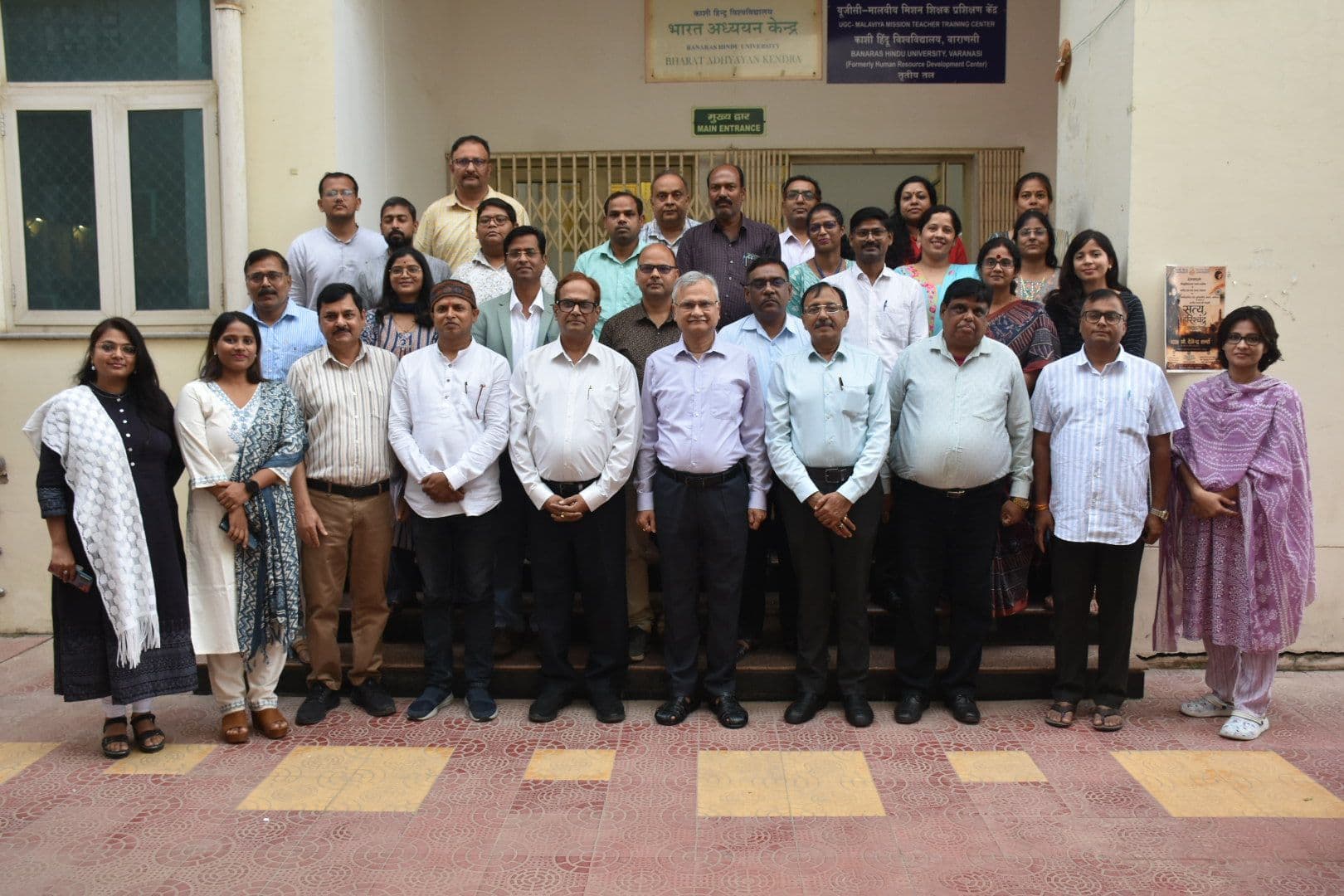
The UGC Malaviya Mission Teacher Training Centre, BHU, is organising a six-day short-term course (August 22–27) on the use of Artificial Intelligence in Higher Education. The course will build educators’ practical skills and understanding to use AI effectively, drive innovation in teaching and learning, and contribute to AI-driven transformation within their institutions.
The UGC Malaviya Mission Teacher Training Centre, BHU, is organising a six-day short-term course (August 22–27) on the use of Artificial Intelligence in Higher Education. The course will build educators’ practical skills and understanding to use AI effectively, drive innovation in teaching and learning, and contribute to AI-driven transformation within their institutions.
Speaking at the inaugural session of the course, Vice-Chancellor Prof. Ajit Kumar Chaturvedi, emphasised that AI should be viewed as an assistant, not a replacement. He highlighted how AI has become an accessible technology that can support teaching, learning and research, including helping researchers analyse and understand large bodies of knowledge more efficiently. Prof. Chaturvedi stressed that AI is part of the continuing advancement of technology as it went from early days of computers, and electronic gadgets, therefore, it should not be treated as something magical.
He further highlighted AI’s potential to go beyond conventional information retrieval, explaining that it can help users engage with and make sense of information contained in documents. Citing his own experience of using ChatGPT to explore a literary question, he observed that AI’s capability lies not merely in searching for relevant material, but in understanding the content and presenting meaningful insights from it. As he put it, “This is not Google search. This is beyond Google search. This is semantics.” He concluded by highlighting the importance of networking among participants from different academic disciplines and institutions.
Guest of Honour, Prof. Akhilesh Singh Raghubanshi, Director, IESD, highlighted AI as a disruptive technology that needs to be adopted rather than feared. He explained that LLMs (Large Language Models) have made technology more accessible by allowing users to communicate with it in human language and receive complex analytical outcomes in an understandable form and it should be treated as an assistant, particularly in drafting, research and analysis.
Special guest, Prof. K. Srinivas NIEPA, Delhi, highlighted the need to integrate AI into teaching to improve the quality and effectiveness of classrooms. By questioning Why is this necessary? and why should we actually adopt AI? He emphasised that AI can help make learning more interesting, engaging, interactive, flexible, adaptive and personalised, in line with the objectives of the NEP (National Education Policy) 2020.
Prof. Anand Vardhan Sharma, Director, UGC-MMTTC, BHU, in his welcome address described the series of 12 programmes initiated by the centre of which 9 programmes have already been completed, with 1,248 participants having undergone training two programmes are currently underway, while the present programme marks the beginning of another programme in the series.
Course Coordinator, Dr. Awadhesh Kumar, MMV, highlighted that the six-day offline programme is focused on the practical use of Artificial Intelligence in higher education, aligned with the objectives of NEP 2020. The programme aims to equip educators with practical competence, pedagogical understanding and ethical awareness to use AI in teaching, learning, research and academic administration.
The six-day programme will cover the use of AI in lesson planning, learning resource development, personalised learning, assessment, research, curriculum design and academic administration. More than 50 participants from across India, including Maharashtra, Karnataka, Gujarat, Jharkhand and Kerala, are taking part in the programme.